
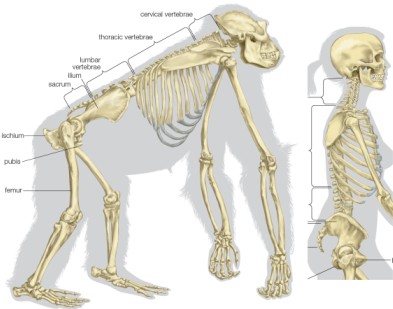
Many people suffer from lower back pain because they lean backward when they stand.
If you’re willing to indulge me and accept that premise, the obvious question is: why?
The simplest answer I have is this — we lean backward because we can.
That’s not meant to be snarky. It’s anatomical.
We have an inward curve in the lower back — the lumbar lordosis — that allows us to lean behind our center of gravity without immediately falling over. And most of us have never been taught how to manage that curve well.
Humans are the only species with such a pronounced inward lumbar curve. The. Only. One.
As Homo sapiens sapiens, we’ve been around for roughly 300,000 years — a blink of an eye compared to the 3+ billion years life has existed on Earth. In evolutionary terms, upright posture is still relatively new.
That inward lumbar curve, shaped in part by the action of the psoas and the reorganization of the pelvis, is what allows us to stand and walk on two legs. It is a remarkable adaptation.
But being early adopters of this design comes with a challenge: we haven’t mastered it.
Instead of organizing ourselves so the bones stack and carry our weight efficiently, many of us lean backward into the lumbar spine. The pelvis tucks, the ribs drift back, and the lower back compresses. It feels passive. It feels easy. But over time, it can be costly.
Look at the prevalence of spinal fusion surgeries and discectomies happening every day around the world. Lower back pain is not a rare complaint — it’s almost a cultural norm.
We lean backward because the curve allows us to. Because we don’t know better. Because posture is largely automatic.
And that’s the real challenge: posture isn’t something we’re meant to micromanage every second. It runs in the background, guided by habit and pattern.
Changing it takes attention. Patience. Repetition.
But it’s worth it.
When you bring your weight forward — when the pelvis and spine find a more balanced relationship — the bones can do their job of holding you up. The muscles can work more appropriately. The lower back doesn’t have to bear the brunt of poor alignment.
Establishing a new pattern won’t happen overnight. But over time, healthier alignment can reduce pain, improve movement, and prepare you to age in a body that feels more supported.
And aging, as we all know, isn’t easy.
Better to stand well now than to pay for it later.