Beyond the Curve: Alternative Approaches to Understanding and Treating Scoliosis
We are up to the seventh post in this series, and it continues to expand. At this point, we will move on to the various methods and approaches that can be taken for supporting and rehabilitating scoliosis.
When it comes to scoliosis, conventional medicine offers a relatively narrow lens: observe, brace, or operate. These approaches can be necessary and helpful—but they don’t capture the full complexity of how scoliosis affects the body, mind, and nervous system.
Nor do they account for why some people’s curves stabilize, while others progress, seemingly without clear cause.
In this, and the next several posts, we’ll explore some alternative and emerging theories of scoliosis—and the innovative, body-centered approaches that go with them.
I will start here with Matt Janzen, whose work resonates the most with my way of thinking and working with clients. In the next few posts, I’ll go into other methods such as Schroth, SEAS, and others.
The Janzen Institute: Scoliosis as a Reflexive, Neurological Pattern
The Janzen Institute offers a radically different lens through which to view scoliosis. Rather than seeing it as purely structural, they frame scoliosis as a neuromuscular reflex pattern—an involuntary response to perceived instability or threat within the body.
According to this theory:
- The spine curves and rotates as a protective reflex.
- This reflex is driven not just by muscle imbalances, but by the nervous system’s attempts to compensate for asymmetrical input (from the feet, eyes, jaw, or inner ear).
- The curve becomes a habituated movement and postural strategy, reinforced by time, tension, and repetition.
Treatment at the Janzen Institute involves retraining the nervous system using a combination of sensory-motor techniques, reflex release, and proprioceptive input to interrupt the scoliosis pattern and restore more functional alignment.
Other Theories and Approaches
1. Tensegrity and Fascial Distortion
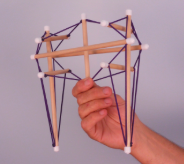
The term “tensegrity” was coined by Buckminster Fuller, but the concept was initially developed and explored by Kenneth Snelson. Fuller combined the words “tension” and “integrity” to describe this structural principle, while Snelson created the first structure that embodied tensegrity.
Fascial tensegrity, as developed by Tom Myers, refers to the structural principle where the body’s fascia (connective tissue) and muscles work together with the bones to create a stable and adaptable system.
Some movement specialists look at scoliosis through the lens of tensegrity—the idea that the body is a web of continuous tension and discrete compression.
From this perspective, scoliosis may result from imbalances in fascial tension rather than bone deformity alone.
Treatment includes:
- Myofascial release
- Fascial unwinding
- Movement therapies that distribute strain more evenly through the body’s web
2. Cranial and Jaw Influence
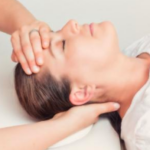
Years ago, I took my children to a craniosacral therapist in the hope of avoiding braces (though, in the end, they did get them). During those visits, the therapist shared an idea that has stayed with me ever since, even though I’ve never been able to find anything that directly corroborates it.
The suggestion was this: scoliosis can, in some cases, be influenced by braces. Since the jaw is essentially the top of the spine, the thinking is that fixing the jaw in place restricts its natural freedom of movement.
If the jaw can’t move freely, that movement has to be expressed somewhere else in the body — and one possible place is the spine, potentially triggering the onset of adolescent scoliosis.
I can’t say with certainty that this theory is correct, but I love it nonetheless. It frames scoliosis not just as a structural issue, but as something deeply connected to how the body seeks balance and freedom of movement.
Craniosacral therapists and some dentists believe that imbalances in the cranial bones or jaw (TMJ) can drive or influence scoliosis patterns via fascial and neurological connections.
Since the dura mater (a connective tissue sheath around the brain and spinal cord) connects from the cranium down the spine, tension here can influence posture and curvature.
This approach may include:
- Cranial osteopathy
- TMJ therapy
- Tongue posture and orofacial myofunctional therapy
3. Vision and Vestibular Influence
The visual and vestibular systems are central to our sense of spatial orientation and balance.
Some practitioners suggest that unresolved visual dominance, eye tracking issues, or inner ear dysfunctions can affect head position, posture, and ultimately spinal alignment.
Vision therapy or vestibular rehab may be part of a multidisciplinary approach to restoring postural equilibrium.
Scoliosis as a Whole-Body Pattern
What these alternate approaches have in common is the understanding that scoliosis isn’t just a spinal issue—it’s a full-body and full-system adaptation. That means:
- Your feet, eyes, tongue, and breath all play a role
- Your nervous system may be holding onto a pattern even after the original stressor is gone
- Shifting the body’s input—whether through movement, touch, or sensory retraining—can change its output
If traditional scoliosis treatment hasn’t fully addressed your symptoms—or if you feel like something’s been missing—alternative approaches may offer a more integrative path. They’re especially useful for:
- Adults with long-standing curves and chronic pain
- People who have plateaued with conventional PT
- Those who intuitively feel their curve is “more than physical”
Of course, not every method will resonate with everyone. But keeping an open mind, and learning to listen more deeply to your body, can reveal possibilities you didn’t know were there.
Scoliosis is not just a curve in the spine—it’s a language your body is speaking.
Traditional tools like bracing and surgery have their place, but so do walking, posture, psoas release, breath, fascia, reflexes, and neuroplasticity.
The more angles we explore, the more holistic—and hopeful—our approach becomes.