
Yoga Talk: Backbends Are Sit-Ups
At first glance, the idea that backbends are sit-ups (or crunches) sounds a little nutty. I can already hear the objections. But stay with me. This isn’t a gimmick or a semantic trick—it’s a useful way to understand what’s actually happening in the spine, and how to keep backbending practices healthy, spacious, and sustainable.
The problem starts with the word backbend itself. Language matters, and imagery matters even more. When students hear “backbend,” many unconsciously imagine bending the body in half from the back, collapsing into the spine and pushing as far as possible into extension. That image encourages effort in exactly the wrong place.
From an anatomy perspective, backbends are really about spinal extension. While it might be more accurate to say, “Let’s work on spinal extension,” backbend sounds far more enticing, so the term is here to stay. That makes it even more important to understand what we’re actually asking the body to do.

A Quick Tour of the Spine
The spine has four curves:
- Cervical (neck) – curves inward
- Thoracic (upper back) – curves outward
- Lumbar (lower back) – curves inward
- Sacral (pelvis) – curves outward and is largely fixed
The cervical and lumbar curves are mirror images. They are designed to move, capable of both flexion and extension. The other two curves are far more limited. The sacrum is fused, and the thoracic spine—designed to protect the heart and lungs—has very little extension.
This matters because in yoga backbends, most of the visible bending comes from the lumbar spine, with some help from the neck. The thoracic spine, despite our best cueing, simply doesn’t extend very much.
Where Things Go Wrong
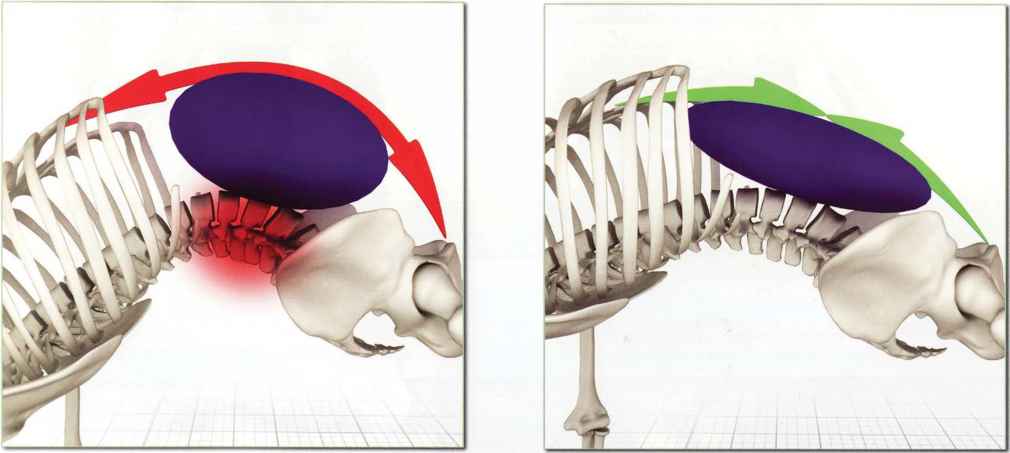
If backbending were just about pushing the back of the body into more extension, we’d be in trouble—and many people are. Without good core tone, especially in the abdominal wall, the lumbar vertebrae are free to collapse toward one another. Instead of space, we get compression.
This is where the sit-up comparison helps.

In a sit-up, rectus abdominis shortens, drawing the rib cage toward the pelvis. That shortening doesn’t just move you forward—it controls spinal movement. Without it, the motion becomes sloppy or injurious.
Backbends work the same way, just oriented differently. For the back of the body to extend rather than collapse, the front of the body must actively shorten. The abs don’t exist to stop backbends; they regulate them, preventing excessive extension in the vulnerable lumbar spine.
When the abs fail to engage, the spine doesn’t lengthen—it crunches. Joints jam. Sensation increases, but not in a good way.
Why Backbends Are Sit-Ups
Here’s the key idea: extension requires flexion to balance it.
If you imagine initiating a sit-up while in a backbend—subtly drawing the rib cage toward the pelvis—you may notice the lumbar spine feels more spacious, not less. Extension becomes distributed rather than dumped into one small area.
This isn’t meant to be anatomically literal; it’s a teaching image. But it’s a powerful one. Healthy backbending isn’t about letting go in the front of the body—it’s about intelligent engagement.
In poses like wheel (urdhva dhanurasana), students often push harder through the arms and legs while neglecting the belly. Try the opposite. Begin a sit-up from the rib cage and notice the support, lift, and lightness that can appear in the lower back.
Where the Psoas Fits In

No discussion of backbending is complete without the psoas. Often mislabeled as just a hip flexor, the psoas connects the inner thigh to the lumbar spine and sits at the crossroads of the legs, pelvis, and spine.
When the psoas is tight or dominant, it tends to pull the lumbar spine into excessive extension. In backbends, this shows up as the familiar hinge in the lower back: lots of sensation, very little space.

This is where abdominal engagement becomes essential. When the rectus abdominis engages intelligently, it gives the psoas something to work against. Instead of cranking the spine into extension, the psoas can help organize the hip–spine relationship more evenly. The pelvis stabilizes, the lumbar curve distributes, and the backbend becomes more whole-body.
The abs and psoas aren’t enemies—they’re partners. When the abs disengage, the psoas often overworks. When the abs engage well, the psoas can soften or at least stop dominating the movement. This is why many people feel relief when they stop trying to “relax the belly” in backbends.
Backbending as Core Organization
Seen this way, backbends aren’t really about bending at all. They’re expressions of core organization under load. They ask the front of the body to shorten intelligently, the back of the body to lengthen with support, and the psoas to cooperate rather than hijack the movement.
Thinking of backbends as sit-ups isn’t just clever—it’s practical. It reduces lumbar compression and creates backbends that feel expansive instead of aggressive.
If your goal is longevity rather than acrobatics, this distinction matters. A lot.