
There are many ways to injure a muscle. The most common are strains — what we casually call “pulls.” These are typically classified into three grades.
A first-degree strain involves a small number of muscle fibers. It’s mild, uncomfortable, and usually heals without much drama.
A second-degree strain affects a larger portion of the muscle. Strength is compromised, swelling is more noticeable, and healing takes longer.
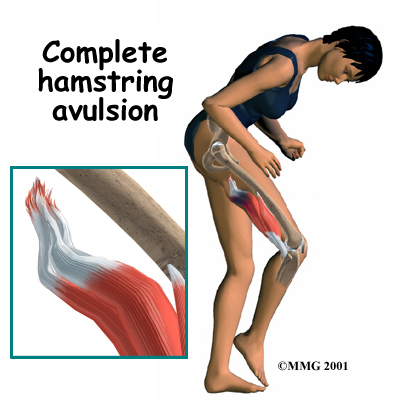
A third-degree strain is the dramatic one — a complete tear. In some cases the muscle can pull away from its tendon or bony attachment. This is the kind of injury you see when a sprinter suddenly grabs the back of their leg mid-race and stops in their tracks.
Muscles tear for different reasons.
One common cause involves something called reciprocal inhibition — the built-in relationship between opposing muscle groups. When one muscle contracts, its opposite is supposed to relax and lengthen. That coordinated exchange allows smooth, efficient movement.
When this system fails — when the opposing muscle doesn’t release — the contracting muscle meets unexpected resistance. The result can be a spasm, and in more extreme cases, a strain or tear. This is an injury born of dysfunctional movement.
That’s different from blunt force trauma. A car accident, a fall, or a sports collision can bruise or tear muscle through direct impact. In those cases, the injury is mechanical rather than patterned.
Healing: The Classic Approach
The traditional first response to a muscle injury is RICE:
-
Rest
-
Ice
-
Compression
-
Elevation
All four strategies are designed to control swelling. Inflammation is part of healing, but excessive swelling can delay recovery and increase pain. I don’t oppose the RICE protocol — though I’ll admit I don’t always follow it strictly.
Once acute swelling subsides, the real work begins.
Muscle vs. Ligament: An Important Distinction
It’s crucial to understand the difference between muscle injuries and ligament injuries.
Ligaments connect bone to bone. When injured, they need relative immobilization. Stressing a healing ligament — even if it feels temporarily good — can delay or disrupt proper repair.
Muscles are different. Muscle tissue has a richer blood supply and a greater capacity to regenerate. A strained muscle can often benefit from gentle, progressive movement once the acute phase has passed. Carefully warming it up and gradually restoring range of motion can actually support healing.
The key word is carefully.
Every time you “tweak” an injury — that sharp reminder that you’ve gone too far — you are essentially re-injuring the tissue. Intelligent loading helps. Repeated aggravation does not.
This is where things get nuanced. You want to encourage circulation and restore function without crossing the line into re-strain.
And then, of course, there’s bursitis — inflammation of a bursa — which adds another layer of complexity altogether.
I’ll save the story of tearing my hamstring completely off its attachment — and the five-year healing process that followed — for another post.